




Economic Insights
This collection of the latest updates and data from the systems integration industry explores leading indicators including the CEO Confidence Index, Purchasing Managers Index, and CSIA updates. We offer our own insights based on the information referenced and interactions with Exotek clients and the SI community.

CEO Confidence Index and PMI
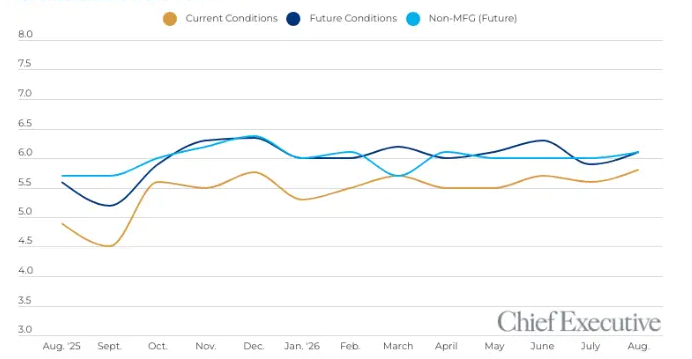
Manufacturing CEO Confidence Improves as Capital Investment Rebounds
Manufacturing CEO confidence improved in August as stronger demand, healthy order backlogs, easing geopolitical tensions, and improving margins gave executives greater confidence that conditions are stabilizing. Manufacturers also reported a meaningful rebound in capital investment plans, although inflation, tariffs, and regulatory uncertainty continue to temper their outlook.
- Current Conditions: Manufacturing CEOs rated current business conditions 5.8/10, up 4% from July and above the 5.5–5.7 range recorded since February.
- 12-Month Outlook: Increased to 6.1/10 from 5.9 in July, reversing part of the previous month’s decline.
- Revenue Outlook: 70% expect revenue to increase during 2026, down slightly from 73% in July.
- Profit Outlook: 77% expect profits to increase, up sharply from 67% in July.
- Capital Investment: 45% plan to increase capital expenditures, up from 37% in July, a favorable signal for future automation and system integration projects.
- Hiring Outlook: 52% plan to increase headcount, up from 42% in July.
- Key Risks: Inflation, tariffs, inconsistent regulation, and supply-chain disruption remain significant concerns, particularly for manufacturers with international operations.
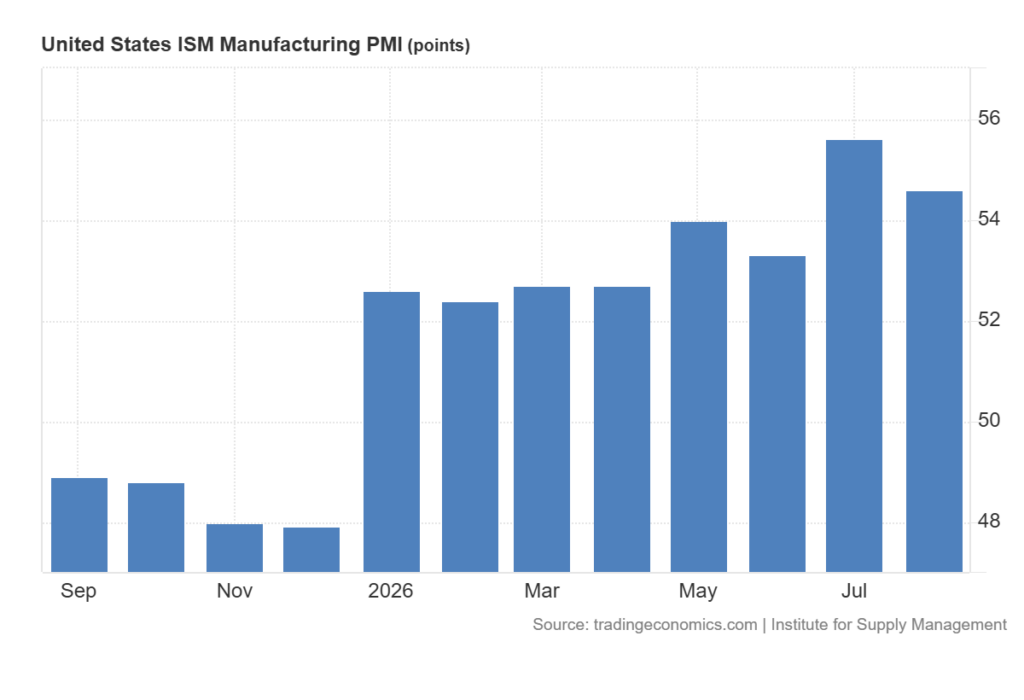
Manufacturing Expansion Remains Strong Despite Moderating Demand
U.S. manufacturing continued to expand in August, although growth moderated from July’s four-year high. Production remained strong, and new orders and backlogs continued to grow, indicating that manufacturers are still working to meet healthy demand. However, slowing supplier deliveries, persistent price pressures, and increased concern about tariffs and geopolitical uncertainty warrant some caution. For system integrators, the overall environment remains favorable, but customers may apply greater scrutiny to new investments as uncertainty and costs increase.
- Manufacturing PMI: Registered 54.6%, while down from 55.6% in July, it marks the eighth consecutive month of manufacturing expansion.
- New Orders: Remained in expansion at 53.7%, although down from 56.7% in July as demand growth moderated.
- Production: Remained strong at 58.3%, essentially unchanged from 58.5% in July and expanding for the tenth consecutive month.
- Order Backlogs: Continued to grow at 51.8%, down from 55.0% in July.
- Customer Inventories: Remained “too low” at 42.8%, generally considered a positive indicator for future production.
- Employment: Remained in modest expansion at 51.2%, down from 52.8% in July.
- Supplier Deliveries: Increased to 59.3%, indicating that deliveries slowed further amid longer lead times and continuing supply-chain pressures.
- Prices: Remained elevated at 71.1% as steel, aluminum, tariffs, and petroleum-related costs continued to pressure manufacturers.
- Industry Breadth: 15 of 18 manufacturing industries reported growth, including five of the six largest industries, demonstrating that expansion remains broad-based.
OUR KEY TAKEAWAYS
Industrial demand remains healthy, although growth moderated in August. Manufacturing CEO confidence improved, and the Manufacturing PMI remained firmly in expansion territory for the eighth consecutive month. While new orders and backlogs grew more slowly than in July, production remained strong and expansion continued across most manufacturing industries.
Capital investment plans rebounded—a favorable signal for system integrators. The percentage of manufacturing CEOs planning to increase capital expenditures rose from 37% to 45%. This suggests that improving confidence, healthy backlogs, and stronger profit expectations are giving manufacturers greater willingness to move forward with investments in capacity, automation, and productivity.
Manufacturers continue to prioritize production and capacity. Production remained near July’s elevated level, backlogs continued to expand, and customer inventories remained too low. Together, these indicators suggest manufacturers must continue increasing output to meet demand, supporting opportunities for system integrators that can improve throughput and operational performance.
Workforce expansion remains measured relative to production needs. Although more manufacturing CEOs plan to increase headcount, the PMI Employment Index remained only modestly above expansion territory and continued to trail production. Manufacturers still need to increase output faster than they are adding workers, reinforcing the business case for automation.
The outlook remains constructive, but uncertainty is increasing. Manufacturing activity remains broad-based, CEO confidence is improving, and capital-investment plans have strengthened. However, slowing demand growth, longer supplier lead times, elevated input costs, tariffs, and geopolitical uncertainty may increase scrutiny of new projects and place greater emphasis on measurable returns.
Services PMI: The Services PMI increased to 55.4% from 54.1% in July, marking the 26th consecutive month of expansion. Business activity and new orders strengthened considerably, supporting continued demand for maintenance, field services, and other recurring service offerings provided by many system integrators.
Non-Defense Capital Goods Excluding Aircraft (UNXANO) ROC Analysis
We have transitioned from tracking US Capital Goods New Orders (USCGNO) to UNXANO which provides a clearer indication of actual capital spending and better aligns with the focus of most system integrators.
Capital Investment Momentum Continues to Accelerate
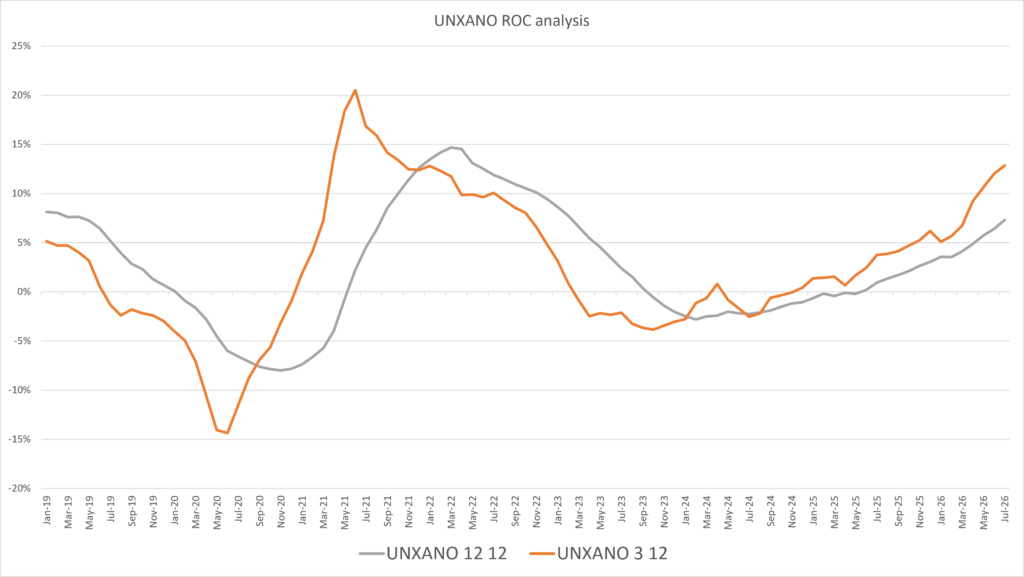
Orders for non-defense capital goods excluding aircraft (UNXANO), a leading indicator of industrial capital investment, totaled $82.4 billion in July, down from June’s elevated monthly reading. However, the rolling 12-month total continued to rise, and both the long- and short-term growth rates accelerated. The stronger three-month rate of change indicates that capital investment momentum continues to build despite normal monthly volatility.
- Capital Goods Orders (UNXANO): Registered $82.4 billion in July, down from $92.2 billion in June but broadly consistent with recent monthly levels.
- Rolling 12-Month Total: Increased to $962.9 billion, up from $951.0 billion in June and reaching a new high.
- 12-Month Growth Rate: Improved to +7%, up from +6% in June, confirming continued long-term growth in capital investment.
- 3-Month Growth Rate: Increased to +13%, up from +12% in June and remaining well above the 12-month growth rate.
- Rate-of-Change Outlook: With both growth rates rising and the three-month rate continuing to lead the 12-month rate, the data indicates that capital-equipment investment is accelerating, a favorable leading indicator for future automation and system integration demand.
Exotek Insights – UNXANO ROC Analysis
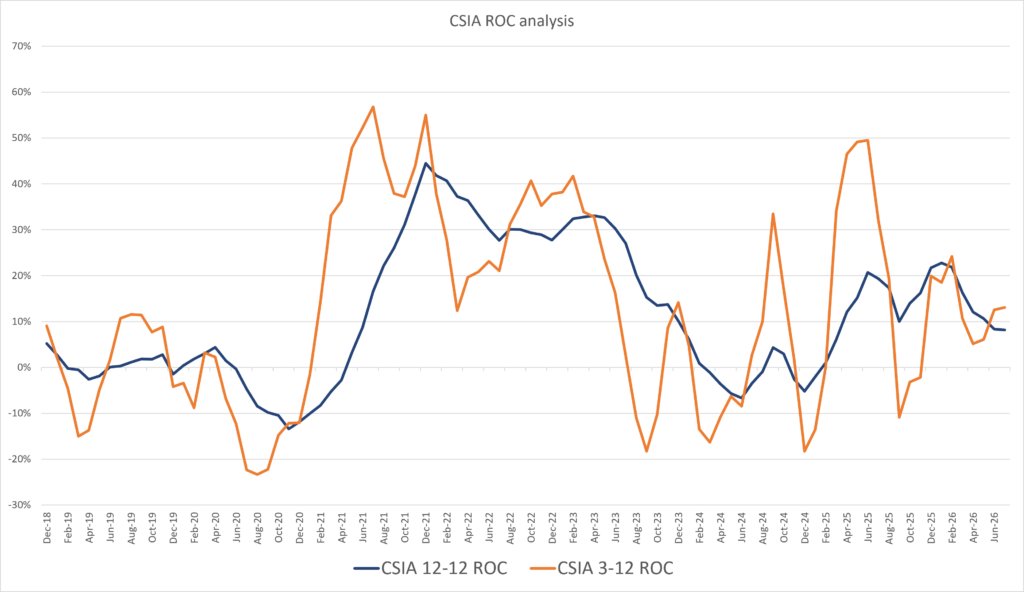
Exotek Insights – CSIA ROC Analysis
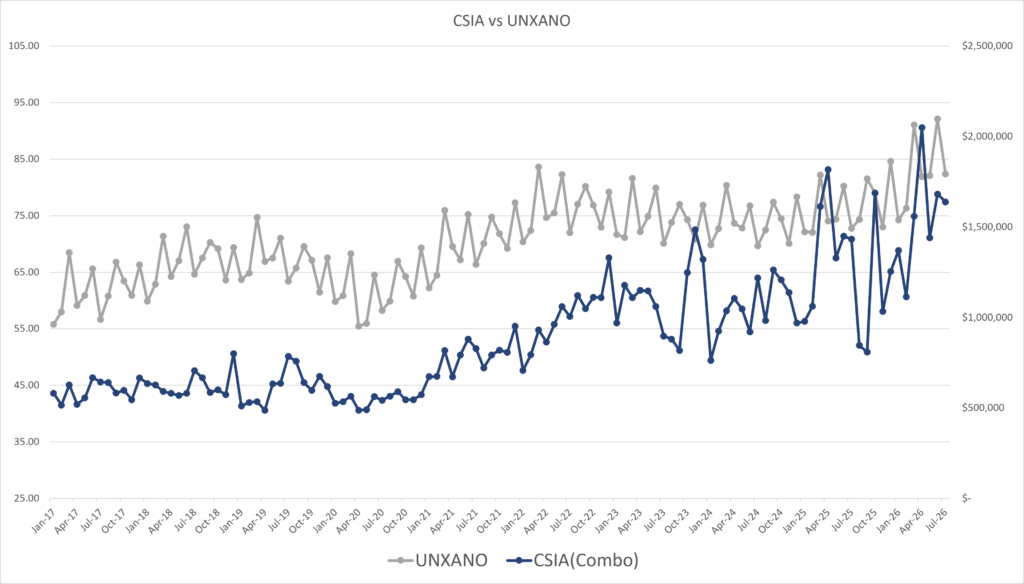
Exotek Insights – CSIA vs UNXANO Analysis
OUR KEY TAKEAWAYS
Capital investment and SI revenue growth are now closely aligned. UNXANO’s three-month growth rate reached 13%, while the CSIA three-month growth rate also held at 13%. Their respective 12-month growth rates reached 7% and 8%, providing strong evidence that increasing industrial capital investment is translating into system integration revenue.
The SI market continues to accelerate. CSIA’s three-month growth rate remains well above its 12-month rate, while combined July revenue was approximately 14% higher than a year ago. Through July, combined CSIA revenue is approximately 12% ahead of the same period in 2025.
Leading indicators are translating into recognized revenue. Industrial automation is a derived market, meaning SI activity generally follows improvements in manufacturing and capital spending as projects are evaluated, approved, engineered, and commissioned. The sustained rise in UNXANO is now clearly reflected in CSIA member revenue.
The outlook remains favorable. Rising capital-equipment orders, strong manufacturing production, improving CEO capital-investment plans, and accelerating SI revenue provide a supportive backdrop for continued growth. Tariffs, input costs, supply-chain disruption, and geopolitical uncertainty remain risks, but they have not yet disrupted the broader growth trend.
CSIA STATS ANALYSIS
OUR KEY TAKEAWAYS
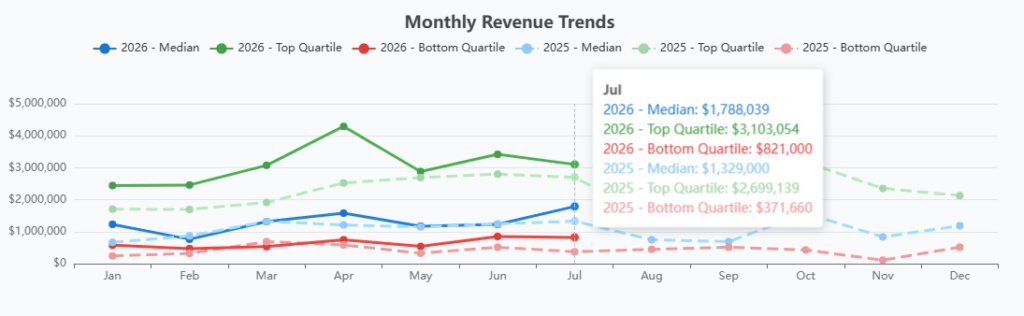
Revenue growth is broad-based across the SI community. July revenue exceeded the same month in 2025 across the median, top, and bottom revenue groups. The median increased to $1.79 million, approximately 35% above July 2025, while the top quartile increased 15% and the bottom quartile more than doubled.
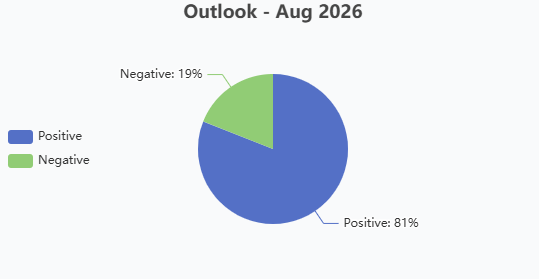
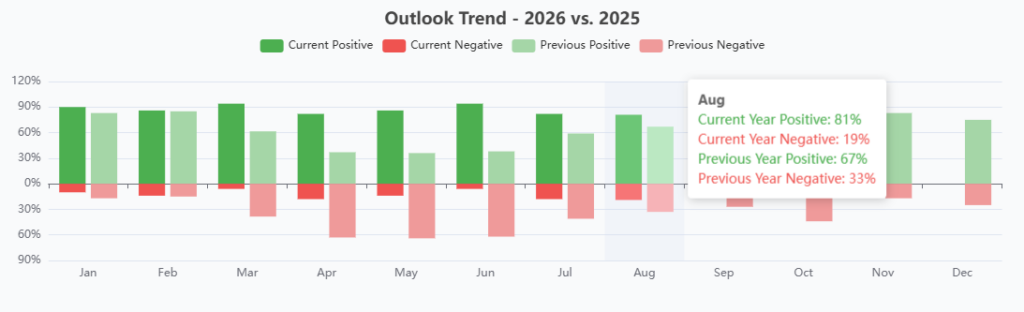
Confidence within the SI community strengthened considerably. 81% of respondents reported a positive outlook in August, up from 67% a year ago. The percentage reporting a negative outlook declined from 33% to 19%, indicating much broader confidence in continued market demand.
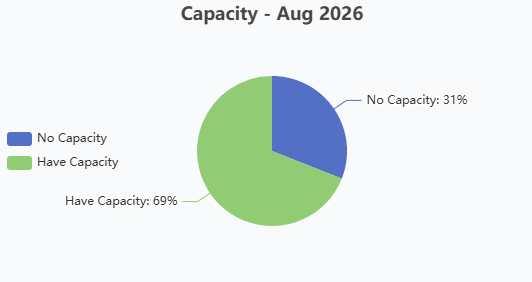
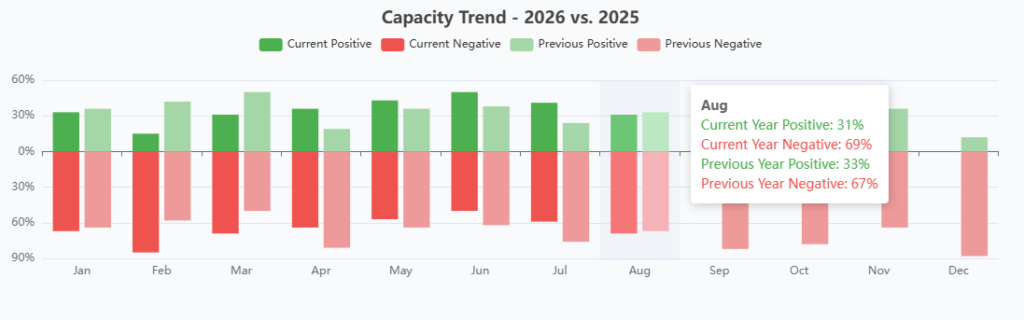
Capacity remains available to support additional growth. 69% of respondents reported having available capacity, compared with 67% in August 2025. Only 31% reported having no available capacity, suggesting that workloads remain healthy without creating widespread delivery constraints.
The market is growing without becoming overheated. Strong revenue growth and improving business confidence point to healthy demand, while the availability of delivery capacity indicates that most integrators remain positioned to take on additional work.
CSIA results reinforce the broader industrial outlook. Rising capital investment, continued manufacturing expansion, stronger customer confidence, and healthy SI revenue are producing consistent signals. The broader industrial economy remains supportive of continued system integration growth.